Public Member Functions |
Static Public Member Functions |
Protected Attributes |
List of all members
RadioHandler Class Reference
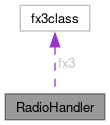
Collaboration diagram for RadioHandler:
Public Member Functions | |
| RadioHandler () | |
| Create a new Radio Handler. | |
| sddc_err_t | Init (SDDC::DeviceItem dev_index) |
| Initialize the RadioHandler instance. | |
| sddc_err_t | AttachReal (void(*callback)(void *context, const int16_t *, uint32_t), void *context=nullptr) |
| Define the function to call when a real sample is available. | |
| sddc_err_t | AttachIQ (void(*callback)(void *context, const sddc_complex_t *, uint32_t), void *context=nullptr) |
| Define the function to call when an IQ sample is available. | |
| sddc_err_t | Start (bool convert_r2iq) |
| Start the SDR data stream and processing functions. | |
| sddc_err_t | Stop () |
| Stop the SDR data stream and processing functions. | |
| sddc_err_t | Pause () |
| Pause the data transmission from the SDR. | |
| sddc_err_t | Resume () |
| Resume data transmission from the SDR. | |
| sddc_err_t | SetDecimation (uint8_t decimate) |
| Set the decimation factor of the FFT. | |
| sddc_rf_mode_t | GetBestRFMode (uint64_t freq) |
| Return the best RF mode to use for the frequency given. | |
| sddc_rf_mode_t | GetRFMode () |
| Return the current RF mode. | |
| sddc_err_t | SetRFMode (sddc_rf_mode_t mode) |
| std::array< float, 2 > | GetADCSampleRateLimits () |
| Get the limits of the ADC of your SDR. | |
| uint32_t | GetADCSampleRate () |
| sddc_err_t | SetADCSampleRate (uint32_t samplefreq) |
| uint32_t | GetCenterFrequency () |
| Get the frequency currently tuned in the SDR. | |
| sddc_err_t | SetCenterFrequency (uint32_t freq) |
| Set the frequency tuned in the SDR. | |
| std::vector< float > | GetRFGainSteps (sddc_rf_mode_t mode=NOMODE) |
| std::array< float, 2 > | GetRFGainRange (sddc_rf_mode_t mode=NOMODE) |
| float | GetRFGain () |
| sddc_err_t | SetRFGain (float new_att) |
| std::vector< float > | GetIFGainSteps (sddc_rf_mode_t mode=NOMODE) |
| std::array< float, 2 > | GetIFGainRange (sddc_rf_mode_t mode=NOMODE) |
| float | GetIFGain () |
| sddc_err_t | SetIFGain (float new_gain) |
| bool | GetBiasT_HF () |
| sddc_err_t | SetBiasT_HF (bool new_state) |
| bool | GetBiasT_VHF () |
| sddc_err_t | SetBiasT_VHF (bool new_state) |
| bool | GetDither () |
| sddc_err_t | SetDither (bool new_state) |
| bool | GetPGA () |
| sddc_err_t | SetPGA (bool new_state) |
| bool | GetRand () |
| sddc_err_t | SetRand (bool new_state) |
| sddc_err_t | SetLED (sddc_leds_t led, bool on) |
| float | getRealSamplesPerSecond () const |
| float | getIQSamplesPerSecond () const |
| RadioModel | getHardwareModel () |
| — Hardware infos — // | |
| const char * | getHardwareName () |
| uint16_t | GetHardwareFirmware () |
| void | EnableDebug (void(*dbgprintFX3)(const char *fmt,...), bool(*getconsolein)(char *buf, int maxlen)) |
| bool | ReadDebugTrace (uint8_t *pdata, uint8_t len) |
Static Public Member Functions | |
| static size_t | GetDeviceListLength () |
| static std::vector< SDDC::DeviceItem > | GetDeviceList () |
Protected Attributes | |
| fx3class * | fx3 |
Member Function Documentation
◆ AttachIQ()
| sddc_err_t RadioHandler::AttachIQ | ( | void(* | callback )(void *context, const sddc_complex_t *, uint32_t), |
| void * | context = nullptr ) |
Define the function to call when an IQ sample is available.
- Note
- The callback will only be called if
convert_r2iqis set totruewhen callingRadioHandler::Start
- Parameters
-
[in] callback Function called when a real sample is available [in] context User defined context passed to the callback function
- Return values
-
ERR_SUCCESS
◆ AttachReal()
| sddc_err_t RadioHandler::AttachReal | ( | void(* | callback )(void *context, const int16_t *, uint32_t), |
| void * | context = nullptr ) |
Define the function to call when a real sample is available.
- Note
- The callback will only be called if
convert_r2iqis set tofalsewhen callingRadioHandler::Start
- Parameters
-
[in] callback Function called when a real sample is available [in] context User defined context passed to the callback function
- Return values
-
ERR_SUCCESS
◆ GetADCSampleRateLimits()
| array< float, 2 > RadioHandler::GetADCSampleRateLimits | ( | ) |
Get the limits of the ADC of your SDR.
- Return values
-
array<float,2> An array containing, in order, the lower and the higher limit of the ADC in Hertz
◆ GetBestRFMode()
| sddc_rf_mode_t RadioHandler::GetBestRFMode | ( | uint64_t | freq | ) |
Return the best RF mode to use for the frequency given.
- Parameters
-
[in] freq The frequency to test in hertz
- Return values
-
sddc_rf_mode_t
◆ GetCenterFrequency()
| uint32_t RadioHandler::GetCenterFrequency | ( | ) |
Get the frequency currently tuned in the SDR.
- Return values
-
The frequency tuned in hertz
◆ GetRFMode()
| sddc_rf_mode_t RadioHandler::GetRFMode | ( | ) |
Return the current RF mode.
- Return values
-
sddc_rf_mode_t
◆ Init()
| sddc_err_t RadioHandler::Init | ( | SDDC::DeviceItem | dev_index | ) |
Initialize the RadioHandler instance.
- Parameters
-
[in] dev_index The index of the SDR to use. You can get the list of available devices by using the static function of RadioHandler
◆ Pause()
| sddc_err_t RadioHandler::Pause | ( | ) |
Pause the data transmission from the SDR.
- Return values
-
sddc_err_t
◆ Resume()
| sddc_err_t RadioHandler::Resume | ( | ) |
Resume data transmission from the SDR.
- Return values
-
sddc_err_t
◆ SetCenterFrequency()
| sddc_err_t RadioHandler::SetCenterFrequency | ( | uint32_t | wishedFreq | ) |
Set the frequency tuned in the SDR.
- Parameters
-
[in] wishedFreq The frequency to use in hertz
- Return values
-
sddc_err_t
◆ SetDecimation()
| sddc_err_t RadioHandler::SetDecimation | ( | uint8_t | decimate | ) |
Set the decimation factor of the FFT.
- Note
- This function has no effect if
convert_r2iqis set tofalsewhen callingRadioHandler::Start
- Parameters
-
[in] decimate A power of 2 of the decimation to apply to the input signal
radio_handler.SetDecimation(0) // No decimation
radio_handler.SetDecimation(1) // Decimate by 2
radio_handler.SetDecimation(4) // Decimate by 16
- Return values
-
ERR_SUCCESS ERR_DECIMATION_OUT_OF_RANGE
◆ Start()
| sddc_err_t RadioHandler::Start | ( | bool | convert_r2iq | ) |
Start the SDR data stream and processing functions.
- Parameters
-
[in] convert_r2iq Set to trueto output IQ data instead of real samples
- Return values
-
sddc_err_t
◆ Stop()
| sddc_err_t RadioHandler::Stop | ( | ) |
Stop the SDR data stream and processing functions.
- Return values
-
sddc_err_t
The documentation for this class was generated from the following files:
- Core/RadioHandler.h
- Core/RadioHandler.cpp
Generated by
 1.12.0